Sound Bowl
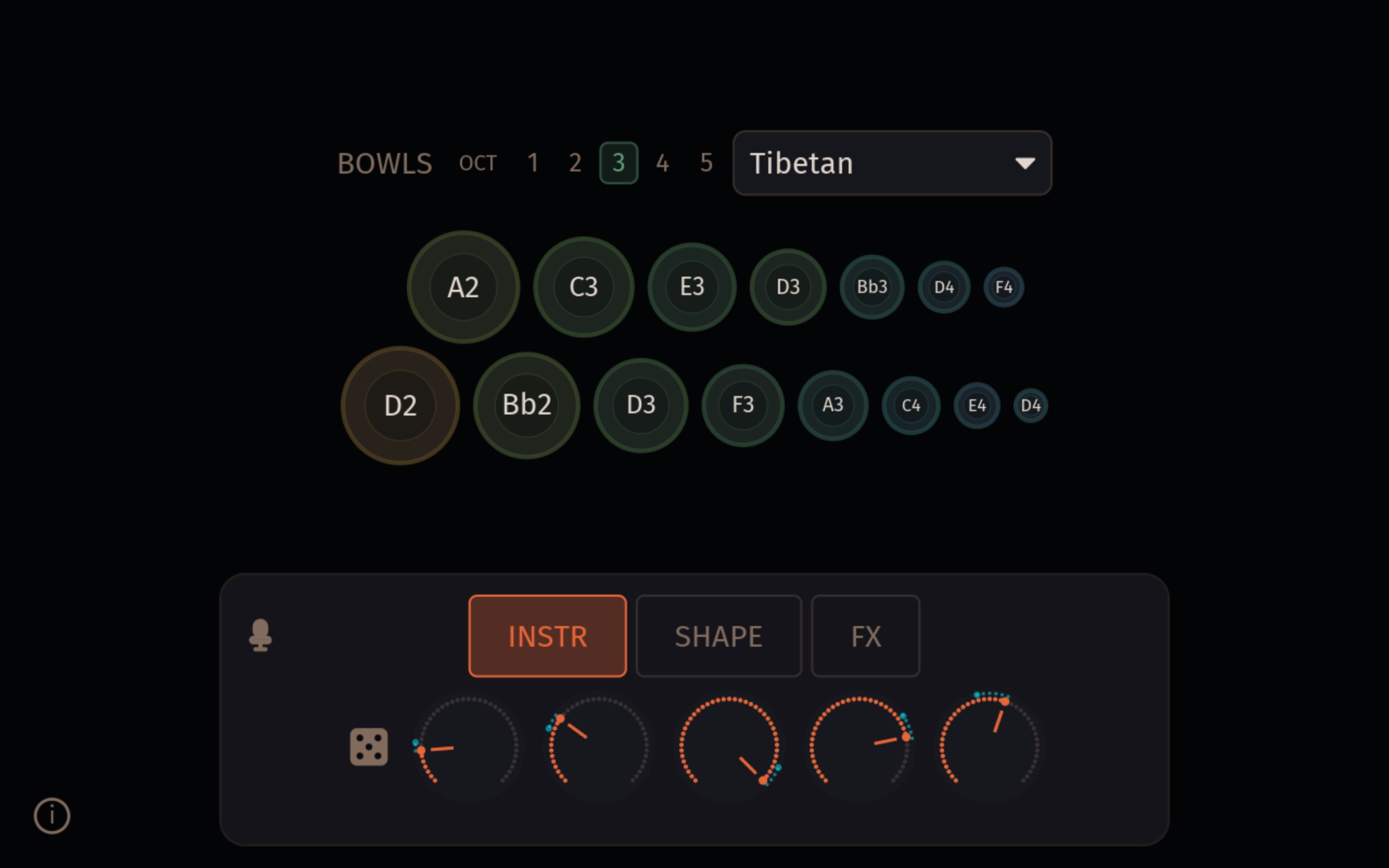
The Sound Bowl is a singing bowl synthesiser with two excitation modes: strike for bell-like attacks, and rub for sustained singing tones.
How It Works
The bowing simulation uses an elasto-plastic friction model to recreate the stick-slip interaction between a mallet and the bowl rim. This produces sustained singing tones with natural harmonic overtones that evolve over time.
Parameters
Available across the standalone app, the Bowl instrument plugin, and the Bowl Resonator effect plugin:
| Parameter | Range | Description |
|---|---|---|
| Scale | 8 factory scales | Bowl tuning — see Scales |
| Brightness | 0–100% | Tone brightness |
| Reverb | 0–100% | Room ambience |
| Decay | 0–100% | Sustain length |
| Volume | –60 dB to +6 dB | Output level |
| Partials | 0–100% | Upper-mode rolloff (lower = darker, fewer high partials) — sits on the INSTR tab alongside Brightness and Hardness because it shapes the instrument's harmonic content |
| Sympathetic | 0–100% | Sympathetic resonance between bowls (SHAPE tab) |
| Bow Intensity | 0–100% | Friction pressure for rub mode (SHAPE tab) |
| Sharp | 0–100% | Strike onset sharpness (SHAPE tab; 0 = soft fade-in, 100 = instantaneous) |
| Attack | 0–100% | Per-note attack-envelope range (SHAPE tab; 0 = sharp on every strike, 100 = some strikes ramp in over up to ~3.5 s) |
| Tail | 0–100% | Per-strike dampening simulating a hand resting on the rim shortly after the strike — see Tail Dampening below (SHAPE tab) |
| Jitter | 0–100% | Per-strike randomisation of bow force, ±40% at full setting (SHAPE tab) |
| Bloom | 0–100% | Brief bow-burst on each strike (~200 ms) layered on top of the percussive attack for a "voiced" character (SHAPE tab) |
| Seed | 0–100% | Per-strike PRNG variation (SHAPE tab) — at 0 the strike noise pattern is identical every hit, at 100 each strike sounds micro-different |
Tuning controls — same effect, different UI per surface:
- Standalone / web app — single Master Tuning knob, A4 = 400–480 Hz
- Plugins — split into Transpose (–24 to +24 semitones) and Fine Tune (–50 to +50 cents)
Plugin-only controls:
| Parameter | Range | Description |
|---|---|---|
| Unmapped Notes | Remap / Silence | What to do with MIDI notes that aren't on the active scale (see Scales) |
| MIDI Channel | All / 1–16 | Restrict triggered notes to a channel |
Excitation Modes
Strike
Tap a bowl for a clear bell-like attack. The tone rings and decays naturally based on the Decay parameter.
Rub
Hold on a bowl to enter rub mode. The friction simulation engages and the bowl begins to sing with sustained, evolving harmonics. The Bow Intensity parameter controls how much pressure is applied.
Sympathetic Resonance
The Sympathetic parameter controls how much the bowls resonate with each other. When one bowl is struck or rubbed, nearby bowls will vibrate in sympathy, creating a richer, more complex soundscape.
Tail Dampening
The Tail knob simulates resting a hand on the rim shortly after each strike. It is per-strike: every new note resets the dampening curve, so the knob shapes the length and brightness of every individual ring rather than acting as a global filter.
At higher values, three things happen in parallel:
- The highs roll off. A lowpass filter closes from ~20 kHz down toward ~500 Hz over roughly three seconds. The closure follows a square-root curve so the dampening is already audible by ~1 second in.
- The amplitude tapers. After a 200 ms grace period (so the strike onset stays sharp), an exponential gain envelope kicks in. At Tail = 100 % the voice tapers with a ~6 second time constant (50 % at 4 s, 10 % at 14 s); at 25 % it's closer to ~24 seconds. Long-running bowing is intentionally preserved at the upper end of the knob — the goal is "softer and darker" rather than "fades out fast".
- The bow lifts off. When the rub mode is engaged, the friction force feeding the resonators is multiplied by the same gain envelope as (2). Without this, sustained bowing keeps continuously injecting energy and the dampening would be fighting an ongoing excitation — Tail would feel like it had no effect once you held a bowl.
Listen to the same C4 strike at four Tail values:
- Tail = 0 % — free ringing, the bowl decays only from its own modal damping (reference)
- Tail = 25 % — gentle dampening, ~1.5 dB quieter at 4–5 s than the reference
- Tail = 50 % — moderate dampening, ~3 dB quieter at 4–5 s
- Tail = 100 % — full dampening, ~7 dB quieter at 4–5 s and noticeably darker
…and the same note in rub mode (sustained bowing engaged), where Tail also tapers the friction excitation:
- Bowed, Tail = 0 % — the bow keeps building energy in the resonators; the tone holds steady
- Bowed, Tail = 25 % — friction tapers off, ~2.5 dB quieter at 4–5 s
- Bowed, Tail = 50 % — ~5 dB quieter at 4–5 s
- Bowed, Tail = 100 % — bowing still audibly running, ~12 dB quieter at 4–5 s, with the upper register rolled off
In every file the onset is identical — only the tail differs.
Resonator Effect
The bowl also ships as Orbiter Bowl Resonator — an audio-effect plugin that drives the same harmonic resonator with audio from your DAW track instead of MIDI notes. See Resonator Effects for routing and controls.