Loading Sound Bowl…
Sound Bowl
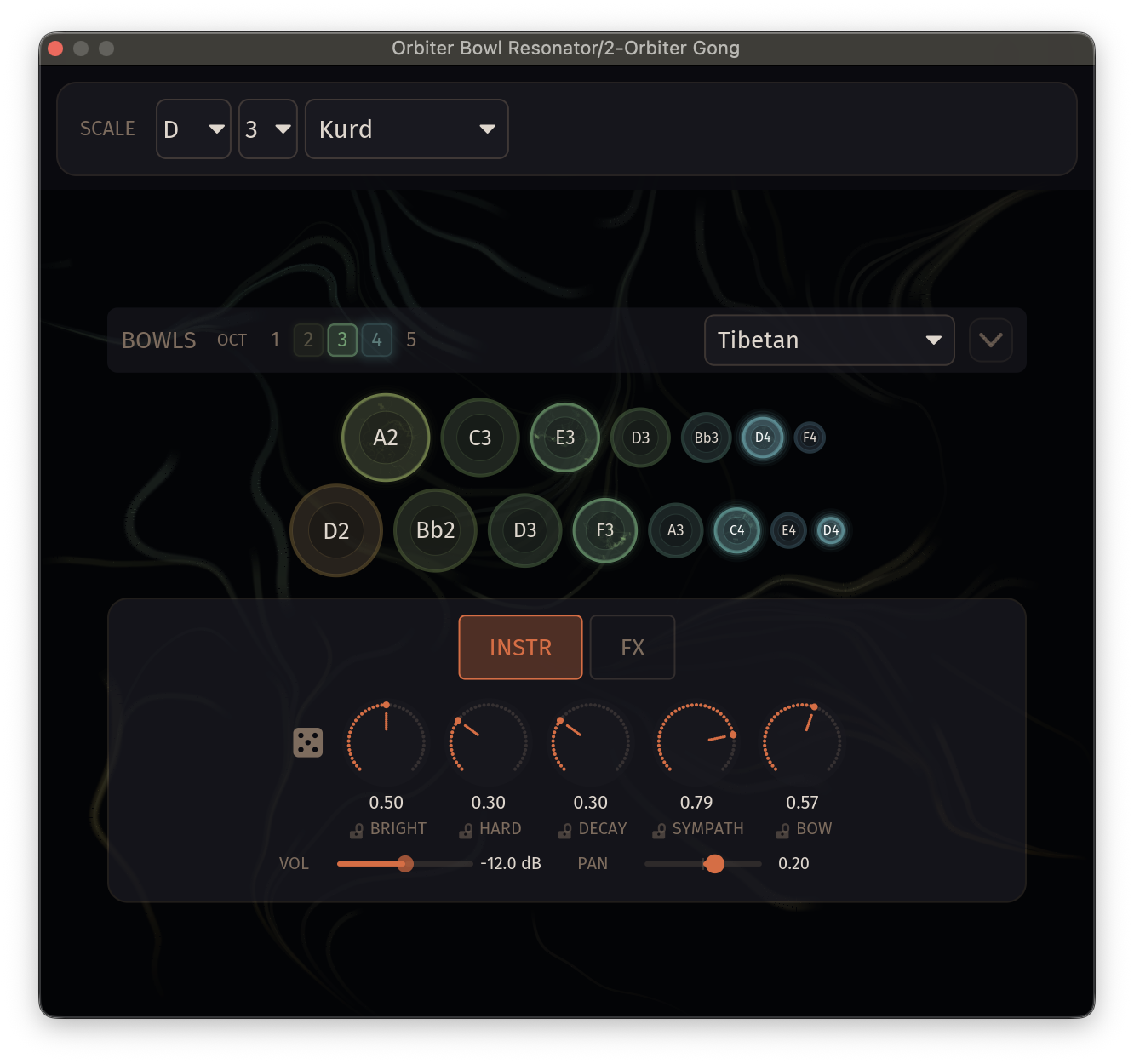
A friction-driven singing bowl model with strike and rub excitation. The bowing simulation recreates the stick-slip interaction between a mallet and the bowl rim, producing sustained singing tones with natural harmonic overtones.
Friction-Driven Bowing
Stick-slip simulation produces sustained singing tones with natural harmonics
Dual Excitation
Strike for a bell-like attack, or hold for sustained evolving tones
Sympathetic Resonance
Bowls resonate with each other for complex, layered soundscapes
Instrument & FX
Play it as an instrument, or route any audio through the resonator as a VST3/CLAP effect
Explore Sound Together
Share a live session and shape the sound together — randomise parameters, tweak patches, and hear every change in real time
MIDI & MPE
Full MPE support for per-note pitch bend, pressure, and slide — connect any controller and play expressively
The puja mallet circles the rim, alternating between sticking and slipping — recreating the friction-driven interaction that produces the singing bowl's sustained voice.
Dual Excitation Modes
Strike a bowl for a clear bell-like attack, or hold to enter rub mode for sustained, evolving tones with rich harmonic content.
Plugin
Available as a VST3 and CLAP instrument plugin, as well as an audio effect (resonator). Route any audio through the bowl's resonator to excite its harmonic modes with external sound.
Research
The singing bowl bowing model uses an elasto-plastic friction simulation to recreate the stick-slip interaction between a puja stick and the bowl rim. Inspired by:
- E. Matusiak, V. Chatziioannou & M. Van Walstijn, "Numerical modelling of elasto-plastic friction in bow–string interaction with guaranteed passivity," Frontiers in Signal Processing, 2025.
- S. Serafin, "The sound of friction: Real-time models, playability and musical applications," Ph.D. dissertation, Stanford University, 2004.
- P. Dupont, V. Hayward, B. Armstrong & F. Altpeter, "Single state elasto-plastic friction models," IEEE Transactions on Automatic Control, vol. 47, no. 5, pp. 787–792, 2002.